




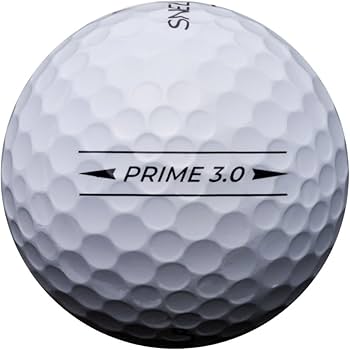
Golf performance is often discussed in terms of swing changes and club technology, but the golf ball remains the only piece of equipment used on every shot. For players who want a consistent blend of distance, control, and feel, construction design plays a major role. The prime 3.0 golf ball represents a modern approach to three-piece ball engineering, built to give everyday golfers balanced performance across the entire bag rather than excelling in just one category.
Many players struggle with the tradeoff between long-game distance and short-game control. Some balls are optimized to go far but feel firm and release too much around the greens. Others offer soft feel but give up speed off the tee. A properly engineered three-piece design aims to reduce that compromise.
Understanding Three-Piece Golf Ball Construction
A three-piece golf ball uses three functional layers: a high-energy core, a performance mantle layer, and a responsive outer cover. Each layer contributes differently depending on impact speed and club type.
The core is responsible for generating ball speed and distance. The mantle layer helps regulate spin and launch conditions, acting as a transition zone between power and control. The cover influences feel, short-game spin, and durability.
This layered structure allows engineers to tune performance more precisely than with basic two-piece balls. Instead of one material doing everything, each layer has a focused role, which leads to more consistent results across different shot types.
Distance Performance Off the Tee
Driver performance depends heavily on energy transfer and spin efficiency. A well-designed core compresses and rebounds quickly, converting swing speed into ball speed. In a three-piece structure, the mantle layer helps keep driver spin from climbing too high, which supports a stronger, more penetrating flight.
For many golfers, this produces more usable distance — not just longer shots, but shots that fly on a stable trajectory and finish predictably. Reduced excess spin also helps limit curvature, which can tighten dispersion.
Distance gains are most meaningful when they come with consistency, and that is where layered construction provides measurable value.
Iron Play and Approach Shot Control
Approach shots demand a different spin profile than drivers. Players want enough spin to hold greens but not so much that distance becomes inconsistent. The intermediate layer in a three-piece ball helps create this separation.
With mid- and short-irons, impact engages the outer layers more directly, increasing spin responsiveness compared to driver strikes. This helps golfers produce repeatable carry distances and more reliable stopping power.
Predictable iron performance simplifies club selection and supports better course management decisions — both critical factors in lowering scores.
Greenside Feel and Short-Game Response
Short-game performance is where cover material becomes especially important. A responsive cover increases friction at impact, which improves spin potential on chips, pitches, and partial wedges. It also influences how soft or firm the ball feels on delicate shots.
Better feel gives golfers clearer feedback, which can improve touch and distance control around the green. This is particularly valuable on faster putting surfaces where small differences in strike translate into meaningful roll differences.
A balanced three-piece ball is designed so that added greenside control does not come at the cost of long-game efficiency.
Who Benefits Most from a Balanced 3-Piece Design
Three-piece performance balls are well suited to a wide range of golfers, especially mid-handicap and improving players who want all-around reliability. Golfers with moderate to moderately fast swing speeds often compress these designs effectively and gain benefits in both distance and control.
They are also a strong fit for players who value consistency across different shot types rather than chasing maximum driver distance alone. When performance gaps between tee shots and wedge shots shrink, scoring opportunities increase.
Even competitive players sometimes prefer balanced three-piece models when they want dependable feel and predictable spin without moving into firmer, higher-layer constructions.
Why Consistency Matters More Than Categories
Labels like “distance ball” or “soft feel ball” can be helpful starting points, but real performance comes from how a ball behaves across the full set of clubs. Golfers benefit most when launch, spin, and feel characteristics work together rather than pulling in different directions.
Playing one model consistently also improves feedback. When ball behavior is stable from round to round, swing adjustments become more meaningful and data-driven.
Final Thoughts
Golf ball technology has advanced to the point where players no longer need to accept major tradeoffs between distance and control. Modern three-piece engineering delivers balanced performance that supports every phase of the game, from tee shots to delicate chips. Choosing a ball built for total performance can produce measurable scoring benefits over time.
Golfers who want performance-engineered designs and player-focused ball technology should review the full lineup available from Snell Golf and consider testing a balanced three-piece model to see how construction quality translates into on-course results.
